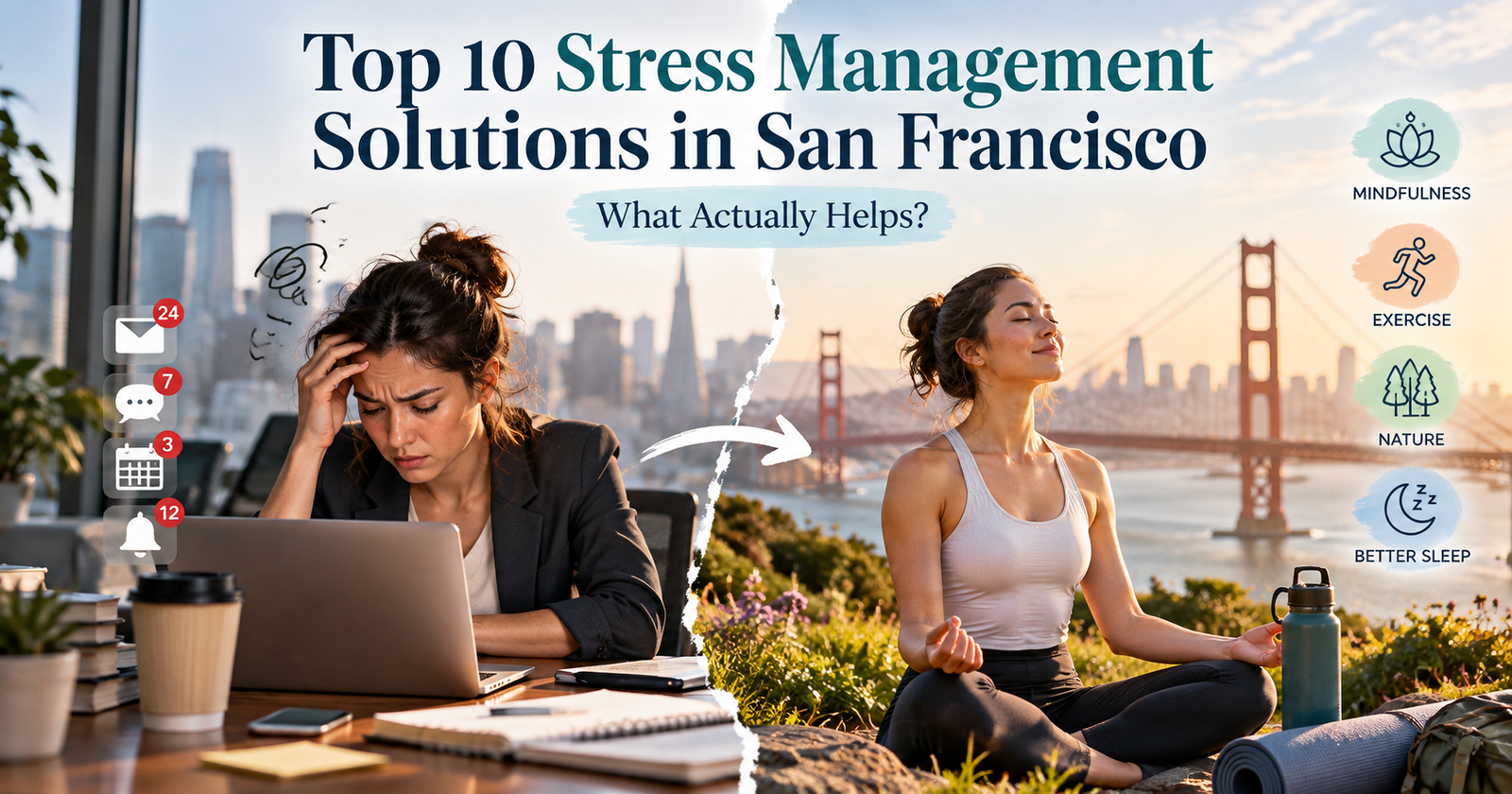
Stress can look different from person to person. For one San Francisco professional, it may mean constantly checking emails after work. For another, it may show up as poor sleep, muscle tension, irritability, racing thoughts, or feeling emotionally exhausted.
The good news is that stress management solutions don’t have to be complicated. Evidence-supported approaches include physical activity, mindfulness, better sleep habits, cognitive-behavioral strategies, relaxation techniques, social support, and professional counseling.
The key is finding an approach that addresses why you’re stressed, not simply trying to distract yourself from it.
What Is Stress Management?
Stress management is the use of practical strategies, techniques, or professional support to reduce the impact of stress and improve how you respond to stressful situations. These strategies can include breathing exercises, relaxation, mindfulness, physical activity, cognitive techniques, and therapy.
For example, someone experiencing constant work pressure may benefit from learning boundaries and cognitive strategies, while someone dealing with occasional tension may find exercise, meditation, or relaxation exercises sufficient.
10 Stress Management Solutions That Can Actually Help
1. Stress Management Coaching
Stress management coaching can help you identify the sources of stress and develop healthier ways to respond to them.
Instead of simply saying “I need to relax,” counseling can help you explore questions such as:
- What situations trigger my stress?
- Why do I react this way?
- Am I taking on too much responsibility?
- Are my thoughts making the situation feel worse?
- What boundaries do I need?
- What coping strategies actually work for me?
Cognitive-behavioral approaches are particularly useful because they can help people identify unhelpful thought patterns and develop more adaptive responses.
Real-life example:
Imagine a San Francisco employee who receives a short message from their manager saying, “Can we talk tomorrow?”
They immediately assume they’ve made a mistake and spend the evening worrying.
Counseling can help them recognize the assumption, examine the evidence, and develop a more balanced response.
2. Mindfulness and Meditation
Mindfulness helps you pay attention to the present moment rather than automatically reacting to stressful thoughts.
Mindfulness-based approaches such as Mindfulness-Based Stress Reduction (MBSR) combine practices such as meditation and mindful movement. Research reviewed by the American Psychological Association has found mindfulness-based interventions can help reduce stress, anxiety, and depression.
You don’t necessarily need an hour of meditation.
Try starting with:
- Sit somewhere comfortably.
- Take slow breaths.
- Notice the sensation of breathing.
- Recognize distracting thoughts.
- Return your attention to the present.
Even a few minutes can become a useful daily habit.
3. Regular Physical Activity
Exercise is one of the simplest stress management solutions because physical activity can support both mood and sleep.
You don’t need an expensive gym membership or intense workout routine.
Consider:
- Walking around your neighborhood
- Cycling
- Yoga
- Swimming
- Strength training
- Dancing
- Hiking
- A short workout between work meetings
A realistic San Francisco example
Instead of spending another 30 minutes scrolling through emails after work, someone might take a brisk walk through a nearby park or neighborhood.
The goal isn’t to “exercise away” every problem. It’s to give your body and mind a healthier transition between work and personal time.
4. Breathing and Relaxation Techniques
Breathing exercises can provide a quick way to create a pause when stress starts building.
Deep breathing and other relaxation techniques are commonly used to help reduce physical tension and promote relaxation.
A simple approach is:
Inhale slowly → pause briefly → exhale slowly → repeat.
You can practice this:
- Before a difficult conversation
- During a stressful commute
- Before an important presentation
- When you notice yourself becoming tense
- Before going to sleep
These techniques are particularly useful because they require little equipment and can be practiced almost anywhere.
5. Better Sleep Habits
Improving sleep can be an important part of managing stress because stress and poor sleep can reinforce each other.
You may feel stressed during the day, sleep poorly at night, and then feel less equipped to handle stress the next day.
Helpful habits include:
- Keeping a consistent sleep schedule
- Creating a wind-down routine
- Reducing stimulating screen use before bed
- Limiting late-day caffeine
- Getting regular physical activity
- Practicing relaxation before bedtime
Think of it as a cycle
Stress → poor sleep → lower energy → reduced coping ability → more stress
Improving sleep can help interrupt that cycle.
6. Cognitive Behavioral Strategies
Cognitive behavioral strategies help you examine the connection between stressful situations, thoughts, emotions, and behaviors.
For example:
Situation: Your supervisor asks for revisions.
Automatic thought: “Everything I do is wrong.”
Emotion: Anxiety and frustration.
Behavior: You continue working late because you’re afraid of making another mistake.
A cognitive-behavioral approach encourages you to question the automatic thought and consider a more realistic interpretation.
7. Setting Healthier Boundaries
Setting boundaries can reduce stress by limiting demands that consistently overwhelm your time and energy.
This can be particularly relevant for professionals who feel permanently connected to work.
Healthy boundaries might include:
- Not checking work email after a certain time
- Saying no to unnecessary commitments
- Taking lunch away from your desk
- Communicating realistic deadlines
- Protecting personal time
- Separating work and home routines
A simple example
Instead of responding to every work message at 9:30 p.m., you might establish a personal rule:
“I’ll respond during my next working period unless the issue is genuinely urgent.”
The objective isn’t to avoid responsibility. It’s to create a sustainable relationship with it.
8. Social Support and Connection
Talking with trusted people can make stressful experiences easier to process and can provide emotional or practical support.
Support might come from:
- Friends
- Family
- A partner
- Coworkers
- Support groups
- A therapist or counselor
- Community organizations
Sometimes you don’t need someone to solve the problem.
You may simply need someone who can listen without immediately telling you what to do.
9. Spending Time in Nature
Time in nature can provide a simple way to create distance from daily stressors and support emotional well-being.
For someone living in a busy city, this doesn’t necessarily require a weekend getaway.
A short walk through a park, sitting outdoors during lunch, or spending time somewhere quieter can create a mental break.
The important part is making the break intentional rather than continuing to work while technically being “outside.”
10. Professional Stress Management Support
Professional support can be especially useful when stress becomes persistent, overwhelming, or difficult to manage alone.
In San Francisco, professional options include individual counseling and psychotherapy practices focused on stress, anxiety, work concerns, and related issues.
For example, local options include San Francisco Stress and Anxiety Center, Bay Area CBT Center, and SF Therapy Group.
Stress Management Coaching vs. Self-Care: Which One Should You Choose?
| Self-Care Strategies | Professional Support |
| Exercise | Counseling |
| Meditation | Psychotherapy |
| Breathing exercises | Cognitive-behavioral strategies |
| Better sleep habits | Personalized stress-management plans |
| Nature walks | Support for recurring stress patterns |
| Social connection | Help addressing underlying concerns |
The two approaches don’t have to compete.
Someone might meditate every morning, exercise several times a week, and still benefit from coaching to address work-related anxiety or relationship stress.
Think of self-care as building everyday resilience, while professional support can provide deeper guidance when stress keeps returning or becomes difficult to manage.
How to Choose the Right Stress Management Solution
The most useful stress management solution depends on the type, intensity, and source of your stress.
If your stress is mostly physical
Consider:
- Exercise
- Stretching
- Breathing exercises
- Relaxation techniques
- Better sleep
If your mind won’t stop racing
Consider:
- Mindfulness
- Meditation
- Cognitive-behavioral strategies
- Journaling
- Counseling
If work is the main source
Consider:
- Boundary setting
- Time-management strategies
- Work and career counseling
- Mindfulness
- Professional stress management support
If stress is affecting relationships
Consider:
- Individual counseling
- Couples counseling
- Communication strategies
- Social support
- Boundary work
What Doesn’t Always Work for Long-Term Stress?
Temporary distractions may provide relief without addressing the underlying source of chronic stress.
For example, watching television for an hour might help someone unwind after work. But if their stress comes from unrealistic workloads, constant people-pleasing, unresolved relationship problems, or persistent anxious thinking, distraction alone may not change the underlying pattern.
The better question isn’t:
“What can make me forget my stress for an hour?”
It’s:
“What is creating this stress, and what can I realistically change?”
That distinction can make stress management much more sustainable.
A Simple 7-Day Stress Management Experiment
You don’t have to completely redesign your lifestyle to start.
Try this one-week approach:
Day 1: Identify your three biggest stress triggers.
Day 2: Take a 20–30-minute walk.
Day 3: Practice five minutes of mindful breathing.
Day 4: Set one work or personal boundary.
Day 5: Talk honestly with someone you trust.
Day 6: Protect your evening wind-down routine.
Day 7: Review what actually made you feel better.
Then keep the strategies that were realistic enough to continue.
When Should You Consider Professional Help?
Consider professional support when stress becomes persistent, interferes with daily functioning, affects relationships or sleep, or feels difficult to manage despite your efforts.
A mental health professional can help determine whether your stress is connected to work, relationships, anxiety, grief, major life changes, or other concerns.
Most importantly, you don’t have to wait until you feel completely overwhelmed before seeking support.
Final Takeaway: What Actually Helps With Stress?
There isn’t one universal stress management solution that works for everyone.
For some people, exercise and better sleep may make a noticeable difference. Others may benefit from mindfulness, relaxation techniques, stronger boundaries, or social connection. When stress is persistent or connected to deeper emotional patterns, professional counseling can provide more individualized support.
The most sustainable approach is often a combination of small daily habits plus targeted professional support when needed.
For San Francisco residents, stress management can be approached in a practical, personalized way rather than as another item on an already overwhelming to-do list. The goal isn’t to eliminate every stressful moment it is to develop healthier ways to respond when stress inevitably appears. If stress is consistently interfering with your work, relationships, sleep, or enjoyment of everyday life, speaking with a qualified mental health professional can be an important next step.