
Stress is a normal part of life, but constant stress can begin to affect your sleep, relationships, work, concentration, and overall quality of life. If you feel overwhelmed, emotionally drained, or unable to switch off your thoughts, stress management therapy in San Francisco can help you understand what is driving your stress and develop healthier ways to respond to it.
Therapy is not simply about talking about your problems. Stress-focused therapy can help you identify patterns, learn practical coping strategies, set healthier boundaries, and build skills that you can use outside the therapy room.
What Is Stress Management Therapy?
Stress management therapy is a form of counseling that helps you understand, reduce, and better manage emotional and physical responses to stress.
A therapist may help you explore the situations, thoughts, behaviors, and relationship patterns that keep your stress active. Depending on your needs, therapy may incorporate approaches such as Cognitive Behavioral Therapy (CBT), mindfulness-based techniques, relaxation strategies, or other evidence-based methods.
The goal is not necessarily to eliminate every stressful situation. Instead, therapy can help you develop a healthier response when stress occurs.
Who Can Benefit from Stress Management Therapy in San Francisco?
You do not have to be in crisis before seeking help.
Stress management therapy may be appropriate if stress is beginning to interfere with your:
- Sleep or ability to relax
- Work or academic performance
- Relationships
- Concentration and decision-making
- Mood and emotional balance
- Ability to enjoy everyday activities
- Confidence in handling difficult situations
Some people seek therapy because of work pressure or burnout, while others experience stress related to relationships, major life changes, financial concerns, family responsibilities, or ongoing uncertainty.
What Happens Before Your First Therapy Session?
Before your first session, you may complete an intake form or have an initial consultation to discuss what brings you to therapy.
A therapist may ask about your current stress, how long you have been experiencing it, how it affects your daily life, and what you would like to change.
You can also use this stage to determine whether the therapist feels like a good fit. San Francisco therapists commonly describe the initial consultation or first session as an opportunity to discuss your concerns, goals, treatment approach, and expectations.
You do not need to prepare a perfect explanation of everything you are experiencing.
Simply knowing “I have been feeling overwhelmed and I want help managing it” can be enough to begin the conversation.
What Should You Expect During Your First Stress Therapy Session?
Your first session will usually focus on understanding your situation, building trust, and establishing goals for therapy.
Your therapist may ask questions such as:
- What is causing the most stress right now?
- When did you first notice the problem?
- How does stress affect your sleep or relationships?
- What have you already tried?
- What would you like to be different?
- Are there situations that consistently trigger stress?
The first session is not a test, and you are not expected to have everything figured out.
The therapist is there to understand your experience and work collaboratively with you.
What Happens During Ongoing Stress Management Therapy?
Ongoing therapy focuses on identifying stress patterns and practicing healthier ways to respond to them.
For example, you might discover that a stressful work situation triggers negative thoughts, physical tension, irritability, and difficulty sleeping.
Your therapist may help you recognize that pattern and work on strategies for responding differently.
Depending on your treatment plan, sessions may include:
- Identifying stress triggers
- Understanding unhelpful thought patterns
- Practicing coping techniques
- Developing healthier boundaries
- Improving emotional regulation
- Learning relaxation or mindfulness skills
- Addressing communication problems
- Reviewing progress between sessions
Some approaches are highly structured and practical, while others may involve more open-ended exploration.
CBT vs. Traditional Talk Therapy for Stress: What’s the Difference?
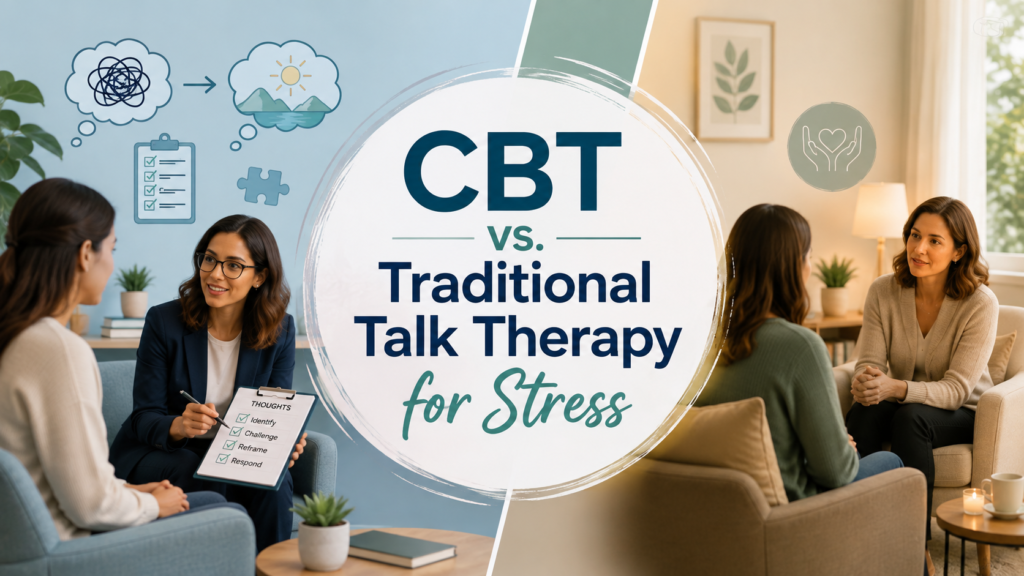
| CBT-Based Stress Therapy | Traditional Talk Therapy |
| Often structured and goal-oriented | May be more exploratory |
| Focuses on thoughts, feelings, and behaviors | Can explore experiences and emotions more broadly |
| Often includes practical exercises | May emphasize reflection and discussion |
| Can involve skills to practice between sessions | Homework may or may not be included |
| Useful when you want concrete coping strategies | Useful when deeper exploration is an important goal |
CBT is often described as a structured, practical approach that helps people identify and change unhelpful thinking and behavior patterns.
Neither approach is automatically better for everyone. The right choice depends on your concerns, goals, preferences, and therapist.
Will Stress Management Therapy Make Stress Disappear?
No. Therapy cannot remove every source of stress, but it can help you respond to stress more effectively.
You may still experience demanding workdays, relationship conflicts, deadlines, unexpected expenses, or major life changes.
The goal is to become better equipped to handle those situations without feeling completely overwhelmed by them.
Over time, you may become better at recognizing stress earlier, calming your response, challenging unhelpful thoughts, and making decisions that support your well-being.
How Long Does Stress Management Therapy Take?
The length of stress therapy depends on your goals, the severity of your stress, and whether other concerns are involved.
Some people benefit from a relatively short course of therapy focused on a specific stressor. Others may need longer-term support when stress is connected to anxiety, depression, trauma, burnout, or long-standing relationship patterns.
Some San Francisco therapy practices describe short-term therapy as lasting roughly 6–12 weeks for certain concerns, while other clients may continue therapy longer based on their needs.
Progress should be discussed regularly rather than assuming that everyone needs the same number of sessions.
What Might You Feel After a Therapy Session?
You may feel relieved, thoughtful, emotionally tired, hopeful, or even uncertain after a session.
Not every therapy session will feel heavy.
Some sessions may involve difficult conversations. Others may feel productive because you gained a new perspective or learned a practical strategy.
It is also normal to feel nervous when discussing personal experiences with someone new. San Francisco therapy resources note that uncertainty, vulnerability, emotional fatigue, and moments of relief can all be part of the therapy experience.
What Does Successful Stress Management Look Like?
Successful stress management is usually about having more control over your response to stress not living a completely stress-free life.
Signs of progress may include:
- Recognizing your triggers earlier
- Sleeping more consistently
- Feeling less overwhelmed
- Thinking more clearly under pressure
- Setting healthier boundaries
- Communicating more effectively
- Recovering faster after stressful situations
- Using coping strategies instead of avoiding problems
Progress can be gradual, and it may look different for every person.
What Can Stress Management Therapy Actually Change? A Client Experience
Stress management therapy can help people become calmer, more present, and better able to handle pressure in their everyday lives.
One publicly shared client testimonial from a San Francisco therapist describes how therapy helped reduce the impact of work-related stress. The client reported that stress from their company no longer disrupted them as much as it had before therapy. They also described becoming less distracted and impatient in conversations with their spouse and feeling calmer and more present.
Client Review: “My stress with my company doesn’t knock me out of whack like it used to when we started.”
The client also described improvements in listening, communication, and being more present with their spouse, team, and customers.
This type of experience highlights an important point about stress management therapy: progress is not always about eliminating stress. It can be about becoming better equipped to respond to stressful situations without allowing them to control your emotions, relationships, or daily life.
How Can You Prepare for Stress Management Therapy?
You do not need to arrive at therapy with everything figured out.
However, it may help to think about:
- What is stressing you the most?
- How does stress affect your daily life?
- What have you already tried?
- What would you like to change?
- What questions do you have for your therapist?
Writing down a few thoughts before your appointment can make it easier to explain what you are experiencing.
How Do You Choose a Stress Management Therapist in San Francisco?
Choose a therapist whose experience, approach, communication style, availability, and treatment goals match your needs.
When comparing therapists, consider:
- Professional credentials and licensing
- Experience with stress, anxiety, or burnout
- Therapy approaches offered
- In-person or online availability
- Session length and scheduling
- Cost and insurance considerations
- Whether you feel comfortable talking with them
A good therapeutic relationship matters. You should feel able to communicate honestly about what is and is not working for you.
Start Stress Management Therapy When Stress Starts Affecting Your Life
You do not have to wait until stress becomes unbearable before seeking support.
Stress management therapy in San Francisco can provide a structured, supportive environment where you can understand your stress patterns, develop practical coping skills, and work toward a healthier daily life.
Whether your stress comes from work, relationships, major life changes, or ongoing personal pressure, the first step is recognizing that you deserve support. If stress is interfering with your sleep, relationships, work, or ability to enjoy life, consider speaking with a qualified mental health professional in San Francisco to discuss whether therapy is right for you.