
Therapy duration varies based on whether you are resolving a temporary situational crisis or unwinding years of behavioral patterns.
- Parent-Child & Teen Communication Struggles: 8 to 12 Sessions (2 to 3 Months)
Focus: De-escalating daily conflict, establishing healthy boundaries, and rebuilding trust.
Realistic Timeline: Families typically notice small shifts by session 4 as ground rules for argument de-escalation take hold.
- Blended Family & Step-Parenting Adjustments: 12 to 20 Sessions (3 to 6 Months)
Focus: Aligning parenting styles, navigating co-parenting boundaries with ex-spouses, and building trust without forcing relationships.
Realistic Timeline: The first month often focuses on managing immediate friction, while months 2 through 5 solidify co-parenting roles.
- Navigating Major Life Transitions or Grief: 6 to 10 Sessions (1.5 to 3 Months)
Focus: Processing shared loss, adjusting to divorce, moving, or managing a major medical diagnosis together.
Realistic Timeline: Short-term, goal-oriented support helps the family build coping mechanisms to process change together.
- Deep-Seated Trauma, Addiction, or Estrangement: 20 to 30+ Sessions (6 to 12+ Months)
Focus: Rebuilding safety, addressing systemic family secrets, repairing severe trust breaches, and establishing firm boundaries.
Realistic Timeline: Progress moves slowly. Early sessions focus entirely on creating emotional safety before addressing core trauma.
Real-Life Scenario: The Miller Family’s 14-Session Timeline
To understand how a typical timeline unfolds, consider the Miller family (parents Mark and Sarah, and 15-year-old Leo). They entered therapy due to explosive shouting matches over grades, screen time, and house rules.
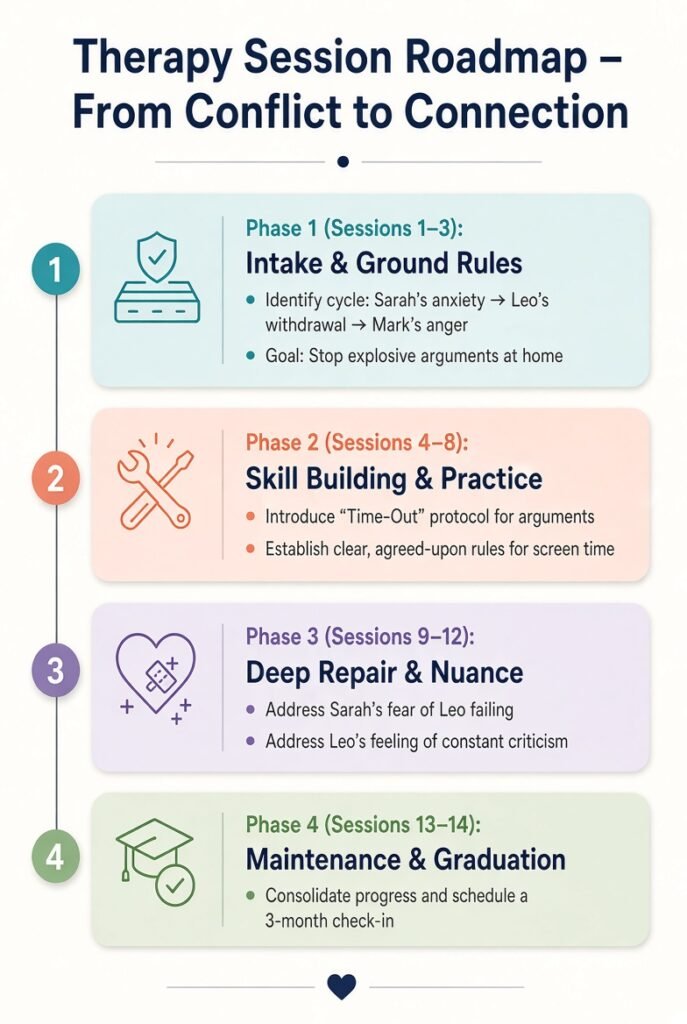
- Phase 1 (Sessions 1–3): Assessment & De-escalation. The therapist mapped out their conflict cycle. Instead of focusing solely on Leo’s behavior, the therapist helped the family see how Sarah’s anxiety triggered Leo’s withdrawal, which then prompted Mark’s harsh discipline.
- Phase 2 (Sessions 4–8): Skill Building. The family learned cool-down strategies and structured communication protocols. Daily shouting matches dropped significantly by session 6.
- Phase 3 (Sessions 9–12): Addressing Core Vulnerabilities. With daily crisis levels down, Mark and Sarah addressed their underlying fears about Leo’s future, while Leo voiced feeling constantly criticized rather than heard.
- Phase 4 (Sessions 13–14): Graduation & Relapse Prevention. The family reviewed their progress, established a plan for handling future disagreements, and transitioned out of weekly therapy.
Total duration: 14 sessions over 4 months.
Brief Strategic Family Therapy vs. Structural Family Therapy vs. Long-Term Systemic Therapy
Different therapeutic modalities follow distinct frameworks and timelines.
| Feature / Metric | Brief Strategic Family Therapy (BSFT) | Structural Family Therapy (SFT) | Long-Term Systemic / Psychodynamic Therapy |
| Typical Duration | 12 to 16 Sessions (approx. 3–4 months) | 15 to 25 Sessions (approx. 4–6 months) | 26+ Sessions (6 to 12+ months) |
| Primary Goal | Target specific youth behavioral issues & family interaction patterns | Restructure family hierarchy, boundaries, & roles | Uncover intergenerational patterns, trauma, & deep emotional dynamics |
| Session Frequency | Weekly | Weekly, transitioning to bi-weekly | Weekly or bi-weekly |
| Best Used For | Conduct issues, truancy, substance prevention | Co-parenting confusion, boundary leaks, parent-child role reversals | Chronic family dysfunction, adult sibling estrangement, deep trauma |
| Homework / Practice | High (actionable tasks between visits) | Moderate (role-play & boundary exercises) | Low to Moderate (insight & reflection) |
5 Factors That Accelerate or Delay Your Family Therapy Timeline
Why do some families finish therapy in 2 months while others require 8 months? The overall length is guided by key internal dynamics:
- Consistency of Attendance: Missing sessions resets momentum. Families attending weekly progress nearly twice as fast as those skipping weeks.
- Active Homework Practice: The real work happens between sessions. Practicing active listening or de-escalation tools at home drastically shortens total therapy time.
- Willingness of All Members to Participate: If one key member refuses to engage or attends reactively, sessions spend extra time managing resistance.
- Number of Issues Addressed Simultaneously: Focusing on one acute goal (e.g., bedtime routine conflict) takes less time than attempting to overhaul communication, finance habits, and extended family dynamics all at once.
- Presence of Individual Mental Health or Substance Use Issues: Unaddressed individual struggles (unmanaged depression, active addiction, severe ADHD) often require individual therapy alongside family sessions, extending the timeline.
What Does Progress Look Like Week by Week?
Family therapy is rarely linear, but progress generally follows a recognizable trajectory:
- Weeks 1–3 (Understanding the Blueprint): You identify the family’s negative interaction loops. You spend less time placing blame and more time spotting triggers.
- Weeks 4–7 (The “Awkward Practice” Phase): You implement new communication rules. Conversations can feel rehearsed or uncomfortable, and minor slip-ups are common, but tension levels drop.
- Weeks 8–12 (Automatic Adoption): New habits take hold. The family self-corrects during arguments at home without needing the therapist to mediate every friction point.
- Maintenance Phase (Bi-weekly to Monthly): Sessions space out to ensure gains hold under stress before officially ending therapy.
When Is Family Therapy Considered “Finished”?
Family therapy is complete when the system functions healthily without the therapist present not when all disagreement vanishes.
Signs You Are Ready to Graduate:
- Arguments are resolved at home using agreed-upon communication tools.
- Family members can express difficult emotions without triggering a total shutdown or explosive blowout.
- Parenting hierarchies and boundaries are clear and respected.
- Members feel safe, heard, and supported within the home environment.
Ready to Transform Your Family’s Communication?
Family conflict can leave everyone feeling exhausted, misunderstood, and distant. But recurring arguments don’t have to be your family’s normal.
While most families experience meaningful breakthroughs in 8 to 20 sessions, the hardest part is simply taking the very first step. Working with a qualified family therapist provides your household with a neutral space, proven communication tools, and a clear roadmap toward long-term peace.
Take the First Step Today
Don’t wait for communication breakdowns to turn into permanent resentment. Help your family rebuild trust, resolve chronic conflict, and connect on a deeper level.
- Book Your Free 15-Minute Consultation: (415) 263-1599
Speak directly with a licensed family therapist to discuss your unique situation and find out if family therapy is the right fit.