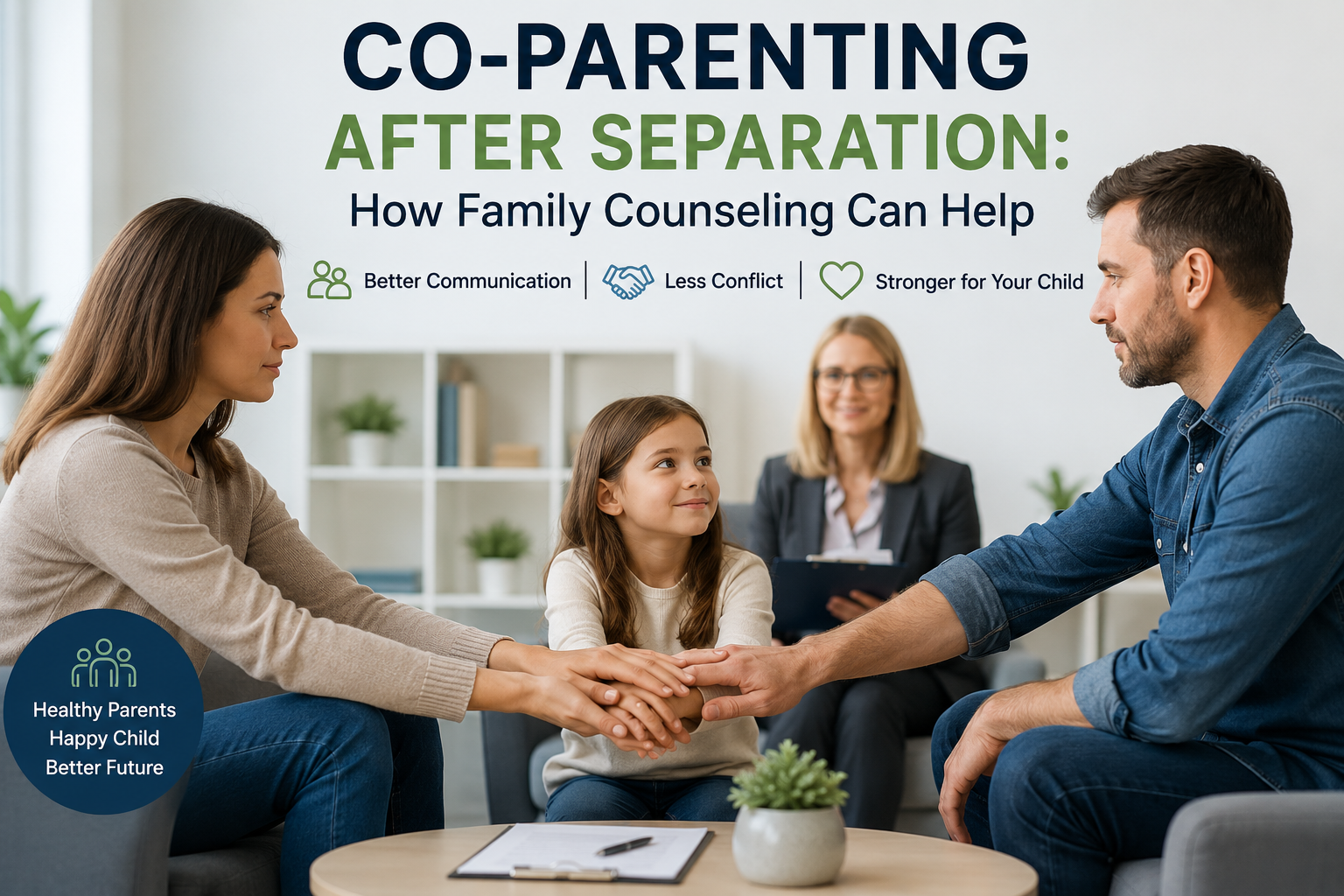
Separation can change a family’s structure, but it does not have to damage the parent-child relationship. Co-parenting after separation means two parents continue working together to support their children, even when they no longer live together.
That can be easier said than done. Emotions, disagreements, different parenting styles, and communication problems can quickly make co-parenting stressful.
Family counseling can help parents build healthier communication, reduce conflict, and create a more stable environment for their children. Research-informed guidance also emphasizes keeping children out of parental conflict, maintaining routines, and giving children reassurance during separation.
What Is Co-Parenting After Separation?
Co-parenting means sharing the responsibilities of raising a child after separation or divorce.
It does not necessarily mean parents must agree on everything. Instead, the goal is to make important parenting decisions while keeping the child’s emotional and practical needs at the center.
Healthy co-parenting may include:
- Communicating about school, health, and activities
- Following an agreed parenting schedule
- Setting reasonable expectations for behavior
- Supporting the child’s relationship with both parents
- Avoiding negative comments about the other parent
- Keeping children out of adult disagreements
Children can experience anxiety, withdrawal, behavioral changes, or other emotional reactions during divorce or separation, making stability and supportive parenting especially important.
Why Is Co-Parenting So Difficult After Separation?
Co-parenting can be challenging because the relationship may have ended while the parenting responsibilities continue.
Common sources of conflict include:
- Different parenting styles — One parent may be stricter while the other is more relaxed.
- Communication problems — Simple conversations can turn into arguments.
- Scheduling disagreements — Holidays, school events, vacations, and exchanges may become stressful.
- Unresolved emotions — Anger, disappointment, or resentment can affect parenting decisions.
- Different household rules — Children may encounter different expectations in each home.
Different parenting styles are not automatically harmful. Children can adapt to different rules when expectations are clear within each household. The bigger concern is ongoing conflict that leaves children confused or anxious.
How Can Family Counseling Help With Co-Parenting?
Family counseling provides a structured environment where parents can address parenting challenges without allowing every conversation to become an argument.
A counselor may help parents:
- Improve communication skills
- Identify recurring sources of conflict
- Practice active listening
- Establish healthier boundaries
- Develop practical parenting strategies
- Create consistent expectations for children
- Discuss difficult parenting decisions
- Focus conversations on the child rather than the former relationship
The goal is not necessarily to restore the relationship between the parents. The goal is to create a healthier parenting relationship.
Family Counseling vs. Handling Everything Alone
| Family Counseling | Handling Conflict Alone |
| Provides a neutral setting | Conversations may become emotional |
| Encourages structured communication | Old relationship issues may resurface |
| Helps identify recurring patterns | The same arguments may repeat |
| Keeps attention on family needs | Parents may focus on winning disagreements |
| Can teach practical communication tools | Each parent may rely on their own approach |
For parents who repeatedly struggle to communicate, professional guidance can provide structure that is difficult to create independently.
What Happens in Co-Parenting Counseling?
Co-parenting counseling usually focuses on practical parenting issues rather than deciding who was right or wrong in the relationship.
Depending on the family’s needs, sessions may explore:
Communication
Parents can learn how to exchange important information without turning every discussion into a personal conflict.
Parenting Decisions
Counseling can help parents discuss school, healthcare, discipline, activities, schedules, and other child-related decisions.
Conflict Management
Instead of reacting immediately to disagreements, parents can learn ways to pause, clarify the issue, and work toward a child-focused solution.
Emotional Support for Children
Children may need space to express sadness, anger, confusion, or worries about the separation. Professional support can help families recognize when additional counseling may be appropriate.
How Can Parents Protect Children From Conflict?
The most important rule is simple: children should not be placed in the middle of adult disagreements.
Parents can protect children by:
- Avoiding arguments in front of them
- Not asking children to deliver messages between parents
- Avoiding criticism of the other parent
- Reassuring children that the separation is not their fault
- Keeping daily routines as consistent as possible
- Allowing children to express feelings without taking sides
- Keeping adult legal or financial disputes away from children
Experts specifically recommend clear, age-appropriate communication and consistent routines to help children adjust to separation.
When Should You Consider Family Counseling?
Family counseling may be especially useful when co-parenting disagreements are becoming repetitive, emotionally intense, or difficult to resolve.
Consider professional support if:
- Every parenting conversation becomes an argument.
- You cannot agree on basic parenting decisions.
- Your child appears increasingly anxious or withdrawn.
- Your child feels responsible for the separation.
- You frequently disagree about discipline or household expectations.
- Communication has completely broken down.
- You want to establish healthier co-parenting habits before conflict escalates.
Significant behavioral changes, withdrawal from activities, recurring nightmares, regression, or heightened fear can be signs that a child may need additional professional support.
Can Co-Parents Have Different Parenting Styles?
Yes. Different parenting styles can coexist when parents maintain respectful communication and reasonable expectations.
One parent may have stricter bedtime rules, while the other may have a different routine. The objective does not have to be making two homes identical.
Instead, parents should focus on important shared priorities such as:
- Safety
- Education
- Respect
- Emotional support
- Healthy boundaries
- Age-appropriate responsibility
Family counseling can help parents decide which differences are harmless and which disagreements need a shared solution.
What If Co-Parenting Is High-Conflict?
High-conflict separation can require more structured professional support. Repeated legal disputes, hostility, inability to resolve disagreements, or behavior that undermines the other parent can make co-parenting particularly difficult.
In these situations, a mental health professional may help determine what type of support is appropriate for the parents and children.
Important: If domestic violence, abuse, threats, or serious safety concerns are present, ordinary joint family counseling may not be appropriate. Safety should come first, and professional or legal guidance should be sought based on the circumstances.
How Can You Start Building Better Co-Parenting Habits?
Start with small, practical changes.
Focus on the child, not the past relationship.
Before sending an emotional message or starting an argument, ask:
“Does this conversation help my child?”
Keep communication short, factual, and focused on parenting when emotions are high. Agree on important routines where possible, and avoid using your child as a messenger.
Most importantly, remember that successful co-parenting does not require perfect agreement. It requires a commitment to your child’s wellbeing.
Final Thoughts: Counseling Can Make Co-Parenting Healthier
Separation may end a partnership, but it does not end the responsibility of parenting.
Family counseling can give separated parents practical tools for communication, conflict management, parenting decisions, and emotional support. When parents learn to work together more effectively, children can have greater stability and reassurance during a major family transition.
If co-parenting feels overwhelming, you do not have to figure everything out alone. Professional family counseling can be a valuable step toward creating a calmer, healthier parenting relationship for everyone involved.