Relationships are rarely perfect. Every couple argues, disagrees, and experiences difficult moments. However, not every argument is a sign of a toxic relationship. One of the most common questions therapists hear is:
“Are we just going through normal relationship conflict, or is our relationship becoming toxic?”
The answer depends on how conflict happens, how partners respond afterward, and whether both people feel emotionally safe.
Understanding the difference can help you decide whether your relationship needs better communication, professional counseling, or stronger personal boundaries.
This guide explains how therapists distinguish healthy relationship conflict from toxic relationship patterns, what warning signs to watch for, and when seeking professional help makes sense.
What Is Normal Relationship Conflict?
Relationship conflict is a natural disagreement between two people with different needs, opinions, personalities, or expectations.
Conflict itself is not the problem. In fact, healthy conflict can strengthen a relationship when both partners work toward understanding each other.
Healthy conflict often includes:
- Different opinions without personal attacks
- Temporary frustration
- Respectful communication
- Listening to each other’s concerns
- Willingness to compromise
- Genuine apologies
- Effort to solve the issue together
Every long-term couple experiences disagreements about:
- Money
- Parenting
- Household responsibilities
- Family boundaries
- Intimacy
- Career decisions
- Time together
- Communication styles
The goal isn’t to avoid conflict.
The goal is learning how to handle conflict respectfully.
What Makes a Relationship Toxic?

A toxic relationship involves repeated unhealthy behaviors that consistently damage one or both partners’ emotional well-being.
Instead of helping the relationship grow, toxic patterns create fear, stress, anxiety, resentment, or emotional exhaustion.
Toxic relationships often involve recurring behaviors like:
- Constant criticism
- Blame
- Manipulation
- Controlling behavior
- Emotional neglect
- Gaslighting
- Verbal abuse
- Threats
- Isolation from friends or family
Unlike normal disagreements, toxic patterns happen repeatedly and rarely improve without significant change.
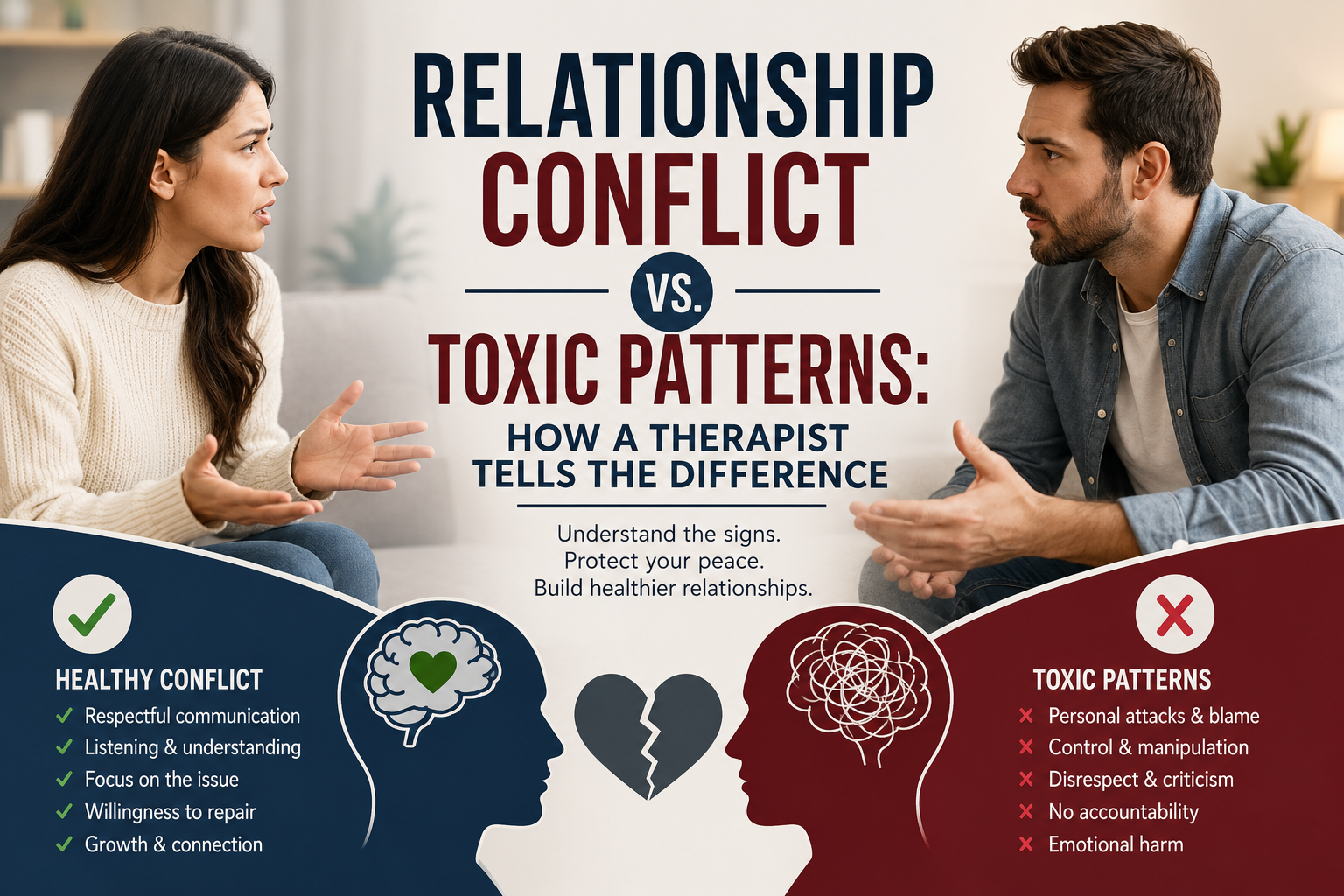
Relationship Conflict vs. Toxic Patterns
| Healthy Relationship Conflict | Toxic Relationship Patterns |
| Disagreements stay focused on the issue | Arguments become personal attacks |
| Both partners listen | One partner dominates conversations |
| Mistakes are acknowledged | Blame is constant |
| Apologies feel sincere | Apologies are manipulative or absent |
| Both feel emotionally safe | One partner feels anxious or fearful |
| Problems eventually get resolved | The same harmful cycle repeats |
| Respect remains during disagreements | Respect disappears during conflict |
| Growth happens over time | Emotional damage increases over time |
The biggest difference is emotional safety.
Therapists ask:
Can both people express themselves honestly without fear of humiliation, manipulation, or punishment?
If the answer is no, the relationship may involve toxic patterns.
How Do Therapists Evaluate a Relationship?
Therapists rarely judge a relationship based on a single argument.
Instead, they look for patterns over time.
They often ask questions such as:
- How often do conflicts happen?
- How are disagreements started?
- How are they resolved?
- Do both partners feel heard?
- Does anyone feel afraid?
- Is there mutual respect?
- Are both partners willing to change?
- Is trust increasing or decreasing?
One difficult conversation rarely signals a toxic relationship.
Repeated harmful behaviors usually do.
Sign #1: Healthy Couples Fight Fair
Healthy couples still become angry.
The difference is how they argue.
They typically:
- Stay on one topic
- Avoid name-calling
- Take breaks if emotions become overwhelming
- Return to finish the conversation
- Focus on solving the problem
- Respect boundaries
Arguments eventually end with greater understanding instead of lasting emotional damage.
Sign #2: Toxic Couples Fight to Win
In toxic relationships, arguments become competitions.
The goal shifts from solving the issue to defeating the other person.
Common behaviors include:
- Bringing up old mistakes
- Insults
- Mocking
- Threats
- Silent treatment
- Emotional manipulation
- Public embarrassment
- Refusing responsibility
Instead of teamwork, conflict becomes emotional warfare.
Sign #3: Repair Happens After Healthy Conflict
One of the strongest signs of a healthy relationship is repair.
Repair means reconnecting after disagreement.
It may include:
- Saying “I’m sorry.”
- Taking responsibility
- Asking how to improve
- Offering reassurance
- Rebuilding trust
Therapists know that healthy couples don’t avoid conflict.
They repair after it.
Sign #4: Toxic Patterns Rarely Include Real Repair
In unhealthy relationships, arguments often end without resolution.
Instead, partners may:
- Pretend nothing happened
- Blame each other
- Repeat the same fight weekly
- Refuse accountability
- Expect forgiveness without changing behavior
Without repair, emotional wounds continue to grow.
Can Conflict Become Toxic Over Time?
Many relationships don’t start as toxic.
Over time, unresolved conflict can slowly develop into unhealthy patterns if neither partner addresses underlying issues.
Examples include:
- Growing resentment
- Poor communication
- Chronic criticism
- Emotional withdrawal
- Loss of trust
- Increasing hostility
This is why therapists encourage couples to seek help before problems become deeply rooted.
What Behaviors Concern Therapists the Most?
Certain behaviors immediately raise concern because they often indicate emotional abuse rather than ordinary conflict.
These include:
- Constant humiliation
- Gaslighting
- Intimidation
- Financial control
- Isolation from loved ones
- Monitoring phones or messages
- Threatening divorce during every disagreement
- Extreme jealousy
- Controlling daily decisions
- Physical aggression
These behaviors are not considered normal relationship conflict.
What Is Gaslighting?
Gaslighting is a form of emotional manipulation where one person causes another to question their own memory, feelings, or reality.
Examples include:
- “You’re imagining things.”
- “That never happened.”
- “You’re too sensitive.”
- “Everyone agrees you’re the problem.”
Over time, gaslighting can reduce confidence and increase emotional dependence.
Therapists take repeated gaslighting very seriously.
Can a Healthy Relationship Have Toxic Moments?
Yes.
Even healthy couples occasionally:
- Say something hurtful
- Lose their temper
- Become defensive
- Shut down emotionally
The important question is:
Does the behavior become a pattern?
Healthy couples usually recognize mistakes, apologize sincerely, and actively work to improve.
Toxic relationships repeat the same harmful cycle with little or no lasting change.
Why Do People Stay in Toxic Relationships?
People stay for many different reasons.
Some common reasons include:
- Love
- Hope that things will improve
- Children
- Financial dependence
- Fear of being alone
- Low self-esteem
- Emotional attachment
- Cultural or family pressure
Therapists avoid judging these decisions.
Instead, they help clients understand their options while prioritizing emotional and physical safety.
How Can Therapy Help?
Relationship therapy doesn’t simply decide who is right.
Instead, therapists help couples:
- Improve communication
- Reduce defensiveness
- Learn conflict-resolution skills
- Build empathy
- Strengthen trust
- Set healthy boundaries
- Recognize destructive cycles
- Develop healthier interaction patterns
When both partners are willing to participate honestly, therapy can significantly improve relationship satisfaction.
When Should You Seek Professional Help?
Consider speaking with a therapist if you notice:
- The same arguments every week
- Constant criticism
- Emotional distance
- Loss of trust
- Feeling emotionally exhausted
- Communication breaking down
- Fear of expressing yourself
- Walking on eggshells
- Frequent resentment
- Difficulty resolving disagreements
Early intervention is often more effective than waiting until problems become overwhelming.
Questions Therapists Encourage Couples to Ask
Rather than asking,
“Who started the fight?”
Therapists often encourage couples to ask:
- What triggered this disagreement?
- What emotion is underneath the anger?
- What need wasn’t being met?
- How could we handle this differently next time?
- What does my partner need to feel understood?
- What do I need to feel emotionally safe?
These questions shift the focus from blame toward understanding.
Healthy Conflict Habits You Can Practice
Many relationship conflicts become easier to manage with intentional habits.
Helpful practices include:
- Listen before responding.
- Speak respectfully, even when upset.
- Avoid absolute statements like “You always” or “You never.”
- Take breaks if emotions become overwhelming.
- Return to difficult conversations calmly.
- Express appreciation regularly.
- Accept responsibility for your own actions.
- Focus on solving the problem together.
Small, consistent changes often have a lasting impact.
Final Thoughts
Every relationship experience conflict. Disagreements alone do not mean a relationship is unhealthy. What matters most is how partners communicate, repair after conflict, and treat each other over time.
Healthy relationships are built on mutual respect, accountability, empathy, and emotional safety. Toxic relationships, by contrast, are marked by recurring patterns of control, manipulation, disrespect, or emotional harm that leave one or both partners feeling drained or unsafe.
If you’re unsure whether your relationship challenges are part of normal conflict or signs of something more serious, speaking with a licensed therapist can provide clarity, practical tools, and a safe space to explore the next steps. Recognizing unhealthy patterns early can make a meaningful difference in protecting both your relationship and your emotional well-being.