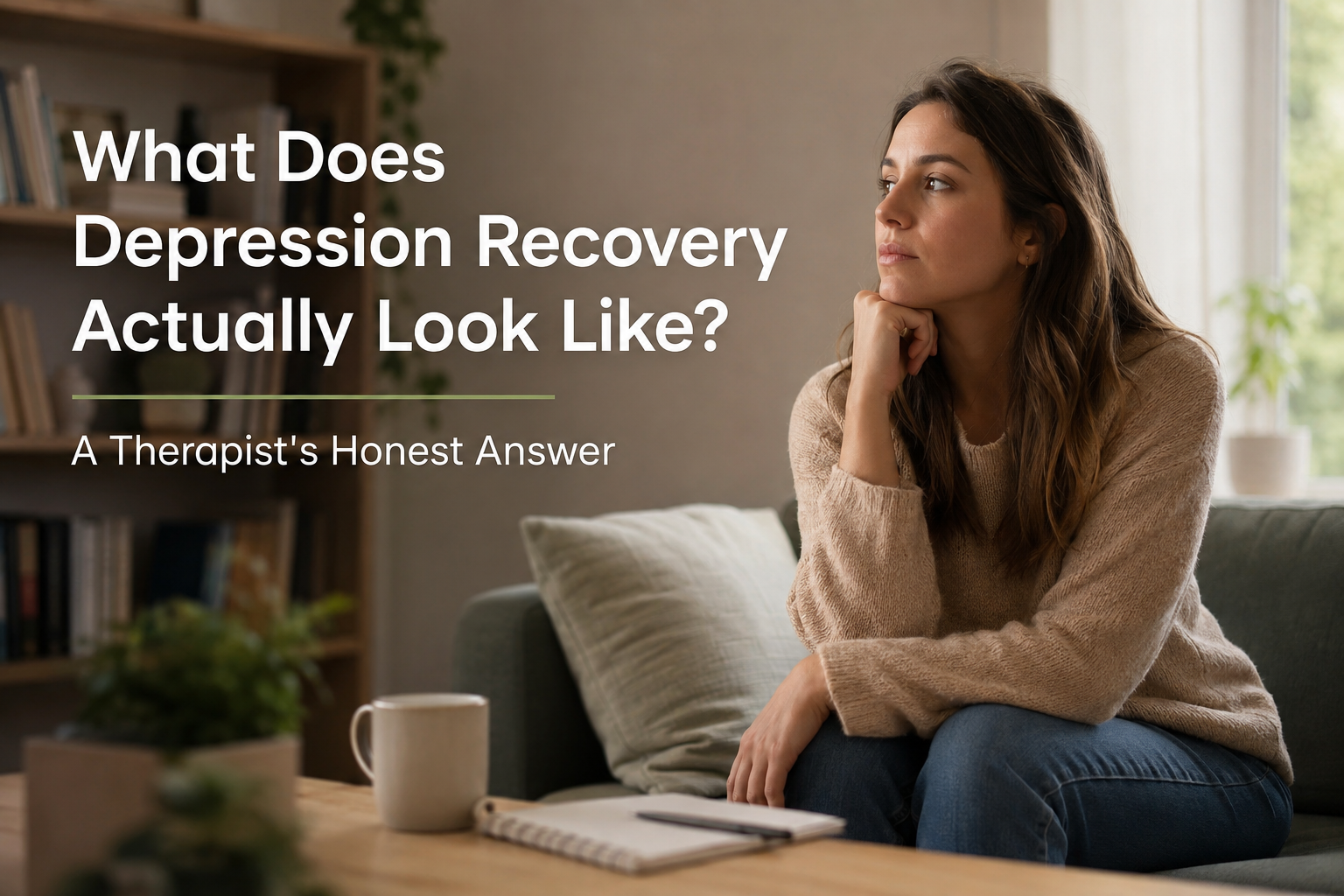
Depression recovery rarely looks like waking up one morning and suddenly feeling happy again. More often, it happens gradually, with small improvements that can be easy to overlook.
A therapist may describe recovery as regaining interest, rebuilding daily routines, reconnecting with people, managing difficult emotions, and becoming more capable of handling setbacks.
The important thing to remember is that recovery is not always linear. Some days feel hopeful, while others may feel surprisingly difficult.
What Does Depression Recovery Actually Look Like?

Depression recovery means gradually becoming more able to participate in life, even when difficult emotions still appear.
Recovery can look like:
- Getting out of bed with less effort
- Taking a shower or preparing a meal
- Returning to work, school, or normal responsibilities
- Enjoying something you previously loved
- Answering messages instead of avoiding everyone
- Sleeping more consistently
- Having more energy during the day
- Thinking about the future again
- Asking for help when you need it
- Feeling emotions without being completely overwhelmed by them
These changes may seem small, but they can represent meaningful progress.
Is Depression Recovery a Straight Line?
No. Depression recovery is usually not a straight line.
You may feel better for several weeks and then experience a difficult day or even a difficult period. That does not automatically mean you have returned to where you started.
Recovery can look more like this:
Progress → setback → adjustment → progress → difficult day → continued recovery
A bad day does not erase weeks or months of improvement.
Instead of asking, “Why am I depressed again?”, consider asking, “What changed, and what support do I need right now?”
The First Signs of Depression Recovery May Be Surprisingly Small
One of the earliest signs of improvement is not necessarily happiness. It may simply be less resistance to everyday life.
For example, you might notice that:
- Getting dressed feels slightly easier.
- You start opening the curtains in the morning.
- You respond to one text message.
- You begin eating more regularly.
- You spend less time lying in bed.
- You become curious about something again.
- You start making plans instead of automatically saying no.
These moments can be easy to dismiss because they do not feel dramatic.
But recovery often begins with these ordinary changes.
Depression Recovery vs. Simply Having a Good Day
A good day and genuine recovery are not necessarily the same thing.
| Having a Good Day | Ongoing Recovery |
| Mood temporarily improves | Functioning gradually improves |
| You may feel better for a few hours | Improvements become more consistent |
| Motivation may suddenly appear | You begin creating routines |
| Symptoms can quickly return | You become better at managing symptoms |
| Improvement may feel random | Progress becomes more sustainable |
The goal is not to feel positive every day.
The goal is to become more resilient, functional, connected, and capable of responding to difficult emotions.
When Does Motivation Come Back?
Many people expect motivation to return before they start doing things.
With depression, the opposite can sometimes happen.
You may need to take a small action before motivation appears.
For example:
Get out of bed → take a shower → eat something → take a short walk → gradually feel more capable.
This is one reason therapists may encourage manageable activities rather than waiting until you “feel like it.”
Small actions can create momentum.
Emotional Recovery Is More Than Feeling Happy
Depression recovery does not mean being cheerful all the time.
A healthier sign of recovery may be that you can experience sadness without believing that your entire life is hopeless.
You might still experience:
- Sadness
- Stress
- Frustration
- Disappointment
- Loneliness
- Anxiety
The difference is that these emotions may no longer completely control your behavior or your view of the future.
You begin to think:
“This is difficult, but I can get through it.”
That shift can be powerful.
Relationships Often Change During Recovery
Depression can make people withdraw from friends, partners, and family members.
As recovery progresses, you may gradually become more willing to reconnect.
That could mean:
- Calling someone you trust
- Accepting an invitation
- Spending time with family
- Telling someone how you actually feel
- Setting healthier boundaries
- Asking for emotional support
You do not need to become highly social overnight.
One meaningful connection can be an important step.
What If You Still Have Bad Days?
Bad days can happen during recovery.
The important question is not simply whether you had a bad day. Instead, look at how you respond to it.
Before recovery, a difficult day might lead to:
“Everything is falling apart. Nothing will ever change.”
With growing recovery skills, the response may become:
“Today is hard. I need to slow down, use my coping strategies, and reach out if I need support.”
The emotion may still be painful, but your response becomes different.
What Therapists Often Look For During Depression Recovery
A therapist may pay attention to changes in several areas rather than focusing only on mood.
Important signs can include:
- Daily functioning: Are basic responsibilities becoming easier?
- Sleep: Is your sleep becoming more regular?
- Social connection: Are you withdrawing less?
- Interest: Are activities becoming enjoyable again?
- Thinking patterns: Are hopeless or self-critical thoughts becoming less dominant?
- Emotional regulation: Can you handle difficult emotions more effectively?
- Self-care: Are you taking better care of your physical and emotional needs?
- Future thinking: Can you imagine positive possibilities again?
Recovery is multidimensional.
Feeling happier is only one part of it.
How Long Does Depression Recovery Take?
There is no universal timeline for depression recovery.
Recovery can depend on factors such as:
- Severity and duration of depression
- Individual circumstances
- Support system
- Treatment approach
- Stress levels
- Physical health
- Previous depressive episodes
- Consistency with treatment and coping strategies
Some people notice changes relatively quickly, while others need more time and ongoing support.
Comparing your timeline with someone else’s usually creates unnecessary pressure.
What Should You Do If Recovery Feels Stuck?
If you have been trying to improve but feel stuck, that does not mean you have failed.
It may mean your current approach needs to be reassessed.
Consider talking with a qualified mental health professional about:
- Persistent symptoms
- Changes in sleep or appetite
- Loss of motivation
- Increasing isolation
- Difficulty functioning
- Treatment that does not seem to be helping
- New or worsening hopelessness
A therapist can help identify barriers and develop strategies that fit your circumstances.
The Honest Truth About Depression Recovery
Depression recovery is often quieter than people expect.
It may not look like suddenly becoming your “old self.”
Instead, you may slowly build a new relationship with yourself, your emotions, your routines, and your life.
You begin noticing that you have choices again.
You start doing things because they matter not simply because you are forcing yourself through another day.
And eventually, a difficult day becomes a difficult day, rather than proof that your entire future is hopeless.
Final Takeaway
Depression recovery is progress, not perfection.
You may still have difficult emotions. You may experience setbacks. You may have days when motivation disappears.
That does not mean recovery has stopped.
Look for the small changes: getting up, reconnecting, caring for yourself, completing responsibilities, enjoying something again, and believing even briefly that tomorrow could be different.
Those small moments can be signs that healing is already happening.
If depression symptoms are persistent, worsening, or interfering significantly with daily life, consider speaking with a qualified mental health professional. And if you are experiencing thoughts of suicide or immediate danger, seek urgent professional or emergency support rather than trying to manage the situation alone.