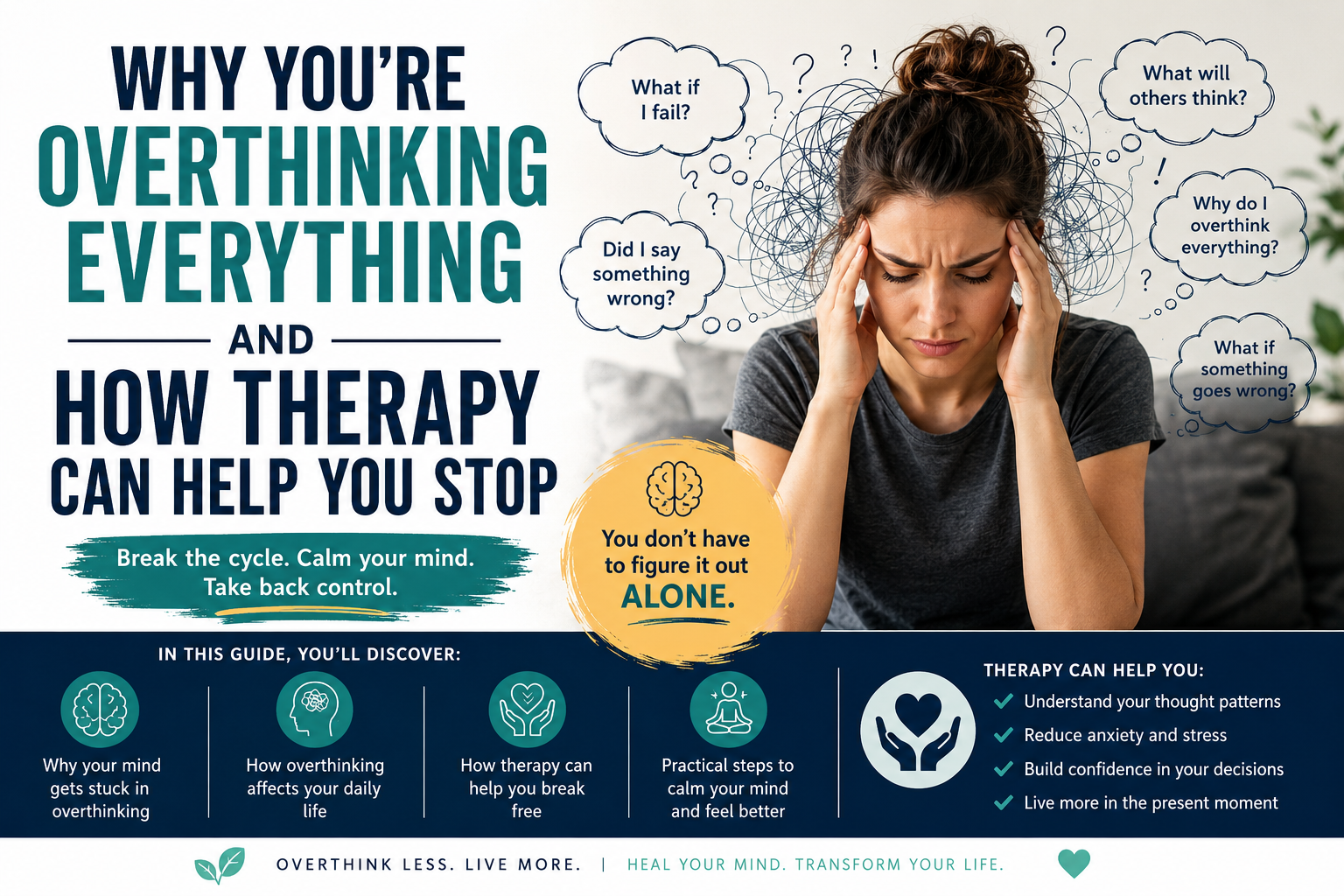
Overthinking can feel like your brain has a “replay” button that never turns off. You analyze conversations, second-guess decisions, imagine worst-case scenarios, and worry about things that may never happen.
Occasional overthinking is normal. But when it becomes a daily habit, it can increase stress, interfere with sleep, affect relationships, and make even simple decisions feel exhausting.
The good news? Overthinking is a pattern that can be understood and changed. Therapy can help you identify why your mind gets stuck and develop healthier ways to respond to anxious or repetitive thoughts.
What Is Overthinking?
Overthinking means repeatedly analyzing, questioning, or worrying about a situation without reaching a useful solution.
For example, you might:
- Replay a conversation from hours ago.
- Wonder whether someone is upset with you.
- Keep changing your mind about a decision.
- Imagine everything that could go wrong.
- Analyze a text message for hidden meanings.
- Worry about mistakes you made in the past.
- Constantly ask yourself, “What if?”
The problem isn’t thinking itself. The problem is getting trapped in repetitive thinking that doesn’t lead to action or resolution.
Why Do You Overthink Everything?

Overthinking often develops as a way of trying to create certainty or avoid mistakes.
Your brain may believe that if you analyze a situation enough, you can prevent something bad from happening. Unfortunately, life rarely provides complete certainty.
Common reasons for overthinking include:
- Fear of making the wrong decision
- Perfectionism
- Fear of judgment or rejection
- Past experiences that made you feel unsafe or uncertain
- Low confidence in your decisions
- Anxiety about the future
- Difficulty tolerating uncertainty
- A strong need to stay in control
In many cases, overthinking isn’t about wanting to worry. It’s your mind attempting to protect you even when the strategy is no longer helpful.
What Does Overthinking Feel Like?
Overthinking can affect both your mind and body.
You may notice:
- Racing thoughts
- Trouble concentrating
- Difficulty making decisions
- Restlessness
- Irritability
- Sleep problems
- Constant “what if?” thoughts
- Mental exhaustion
- Feeling unable to relax
- Repeatedly seeking reassurance
One thought can also trigger another.
“Did I make a mistake?” → “What if they are upset?” → “What if I ruined everything?” → “How can I fix it?”
Before long, a small concern can become a mental spiral.
Overthinking vs. Problem-Solving: What’s the Difference?
Problem-solving focuses on finding a practical solution. Overthinking repeatedly examines the problem without creating meaningful progress.
| Problem-Solving | Overthinking |
| Identifies the issue | Repeats the issue |
| Looks for realistic options | Imagines endless possibilities |
| Leads to action | Often leads to more worry |
| Accepts that uncertainty exists | Tries to eliminate all uncertainty |
| Has a stopping point | Can continue indefinitely |
For example, problem-solving might sound like:
“I need to prepare for tomorrow’s meeting, so I’ll review my notes for 30 minutes.”
Overthinking might sound like:
“What if I say something wrong? What if they don’t like my idea? What if everyone thinks I’m unprepared?”
Healthy thinking moves you forward. Overthinking keeps you stuck.
How Overthinking Can Affect Your Everyday Life
Persistent overthinking can make ordinary situations feel much more difficult.
At work, you may spend too much time worrying about whether your performance is good enough.
In relationships, you may analyze your partner’s words, tone, texts, or behavior.
At night, your mind may become especially active because there are fewer distractions.
Over time, constant mental activity can contribute to:
- Reduced productivity
- Relationship tension
- Decision fatigue
- Difficulty sleeping
- Avoidance of important situations
- Increased emotional stress
- Lower confidence
When your brain is constantly preparing for problems, it can become difficult to simply experience the present moment.
How Therapy Can Help You Stop Overthinking
Therapy doesn’t simply tell you to “stop thinking so much.”
Instead, a therapist can help you understand why your thoughts become repetitive and what keeps the cycle going.
Depending on your individual needs, therapy may help you:
Identify Your Overthinking Triggers
You can learn to recognize situations that activate repetitive thoughts.
For example, your triggers might include conflict, uncertainty, social situations, work decisions, relationships, or fear of failure.
Challenge Unhelpful Thought Patterns
Therapy can help you examine whether your thoughts are based on evidence or assumptions.
Instead of automatically believing:
“Something is definitely going to go wrong,”
you can learn to ask:
“What evidence do I actually have that this will happen?”
Develop Healthier Responses
The goal isn’t to eliminate every uncomfortable thought.
The goal is to respond to thoughts differently.
You can learn to notice a thought without immediately analyzing it, reacting to it, or treating it as a fact.
Build Tolerance for Uncertainty
Many people overthink because they want a guarantee that everything will be okay.
Therapy can help you become more comfortable with uncertainty and recognize that you can handle situations even when you don’t know exactly what will happen.
Improve Decision-Making
When every decision becomes a major mental debate, therapy can help you develop practical strategies for making choices without endlessly second-guessing yourself.
Can Therapy Actually Stop Overthinking?
Therapy can help reduce excessive overthinking and teach you skills for managing repetitive or anxious thoughts. The goal usually isn’t to create a completely silent mind. Everyone has worries, doubts, and unwanted thoughts.
Instead, therapy can help you:
- Recognize thought patterns earlier.
- Separate thoughts from facts.
- Reduce repetitive mental analysis.
- Manage anxiety more effectively.
- Make decisions with greater confidence.
- Stop seeking endless reassurance.
- Focus more on the present.
- Respond to uncertainty in healthier ways.
Progress can take time, but learning how your thinking patterns work can make them easier to manage.
What Can You Do When You Catch Yourself Overthinking?
You don’t have to solve every thought immediately.
Try this simple process:
1. Notice it.
Recognize that you’re caught in a thinking loop.
2. Name it.
Tell yourself, “I’m overthinking this right now.”
3. Ask whether action is possible.
If there is something practical you can do, identify one small step.
4. If there is no action, pause.
Remind yourself that more thinking may not produce more certainty.
5. Return your attention to the present.
Focus on what you’re doing right now rather than continuing the mental conversation.
These techniques may not eliminate overthinking instantly, but they can help you interrupt the cycle.
When Should You Consider Therapy for Overthinking?
Consider speaking with a mental health professional if overthinking is:
- Interfering with your sleep
- Affecting your relationships
- Making everyday decisions difficult
- Preventing you from enjoying activities
- Increasing your anxiety or stress
- Making you constantly seek reassurance
- Interfering with work, school, or daily responsibilities
- Feeling impossible to control on your own
You don’t have to wait until overthinking becomes overwhelming before seeking support.
A therapist can help you understand what is happening and determine which strategies may be appropriate for your situation.
The Bottom Line
Overthinking isn’t a sign that you’re weak or incapable of making decisions. Often, it’s a learned mental pattern connected to anxiety, uncertainty, perfectionism, fear, or past experiences.
The goal isn’t to never have another worrying thought.
The goal is to stop letting every thought demand your attention.
With the right support, you can learn to recognize overthinking, challenge unhelpful patterns, tolerate uncertainty, and make room for a calmer and more present way of living. If overthinking is taking up too much space in your life, talking with a qualified therapist can be a meaningful first step toward understanding your thoughts and changing the cycle.